![[CGM #1] Blood Sugar 202 After a Bowl of Porridge](/ko/cgm-day1-first-blood-sugar-spike/cover_hu_e64d9a6c577dfde4.webp)
TL;DR
- I wore a Dexcom G7 Continuous Glucose Monitor (CGM) for the first time. Why? Just curious.
- My blood sugar skyrocketed to 202 after having a bowl of porridge for breakfast.
- I’m glad I wore it. This is a number I would have never known otherwise.
This is a personal log, not medical advice. Talk to a medical professional about diagnosis or treatment.
I visited a health checkup center and decided to try a Continuous Glucose Monitor (CGM).
It wasn’t because I have diabetes. I was simply curious. I eat every day, drink coffee, and sometimes have late-night snacks. I had never seen how my blood sugar moves through all that. I wanted to see it in numbers.
The device is a Dexcom G7. You attach a coin-sized sensor to the back of your upper arm, and it sends real-time blood sugar data to your smartphone via Bluetooth. I’m using an app called PASTA, developed by Kakao Healthcare. Here, I can see my blood sugar trends on a continuous graph.
 “The greatest happiness in the world is the happiness right before your eyes.” — I was still at peace at this moment.
Table of contents
Attaching the Sensor: Easier Than Expected
I was a bit nervous at first. A needle going in? Surely it would hurt.
But it didn’t hurt at all. You just press it on with a “click” and you’re done. It felt like a slight pinch, nothing more. A few hours later, I forgot I was even wearing it. I only remember when the app sends a notification: “Oh right, I’m measuring my blood sugar right now.”
The sensor lasts for 10 days. This small device records blood sugar every 5 minutes without sleep. Once you put it on, you don’t have to prick your finger for 10 days.
[!NOTE] A Continuous Glucose Monitor (CGM) measures glucose levels by inserting a thin sensor under the skin. Simply put, it’s a device that lets you see real-time blood sugar changes without finger pricks. One Dexcom G7 sensor costs about 100,000 KRW and can be used for 10 days.
First Morning: A Simple Bowl of Porridge
The first morning after attaching the sensor. For breakfast, I ate porridge (juk) using a meal coupon provided by the checkup center.
 I thought this would be a healthy start.
I figured porridge would be fine. It’s not greasy, not spicy. It’s what sick people eat—could it really spike my blood sugar?
I finished the bowl casually, without much thought.
A little while later, I opened the app.
The graph was climbing. Quite steeply.
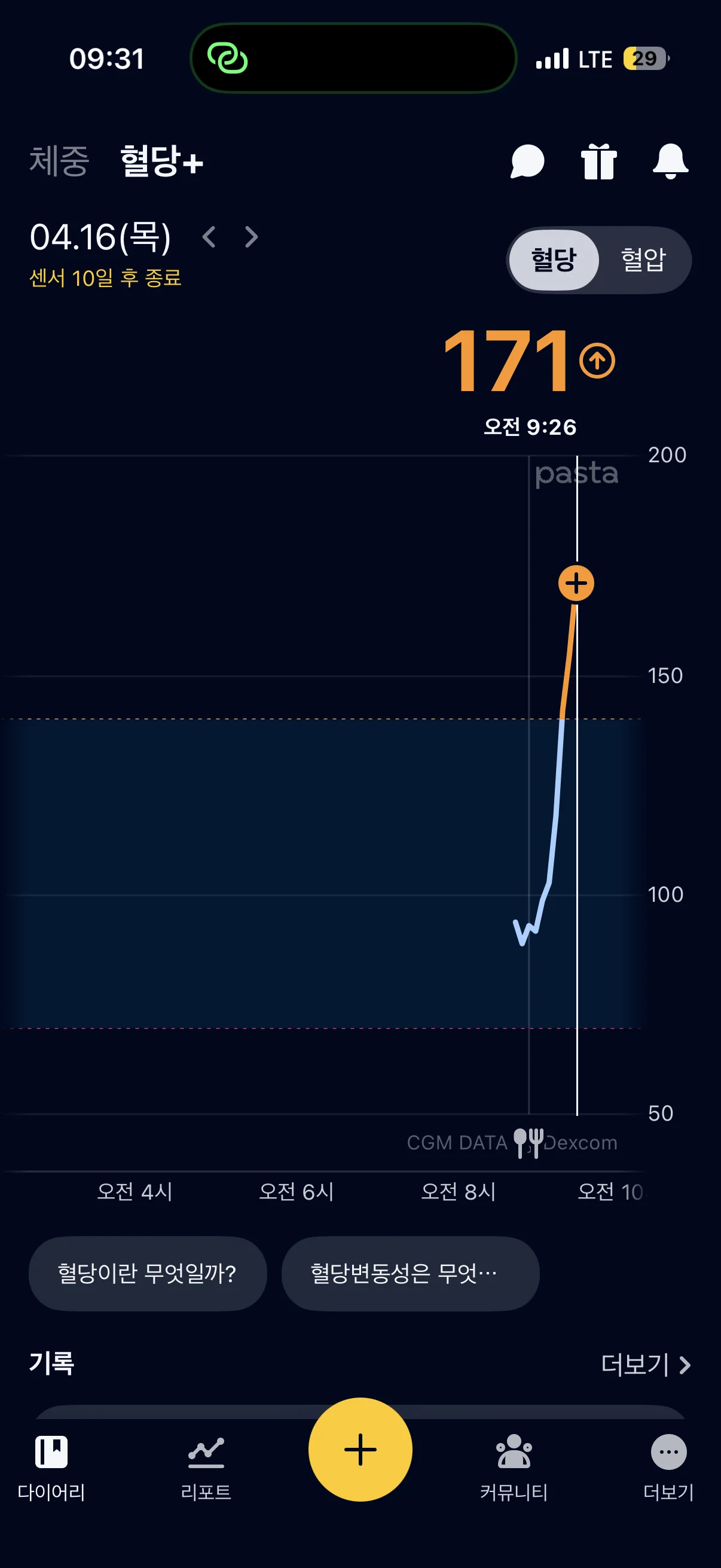 171. And it was still going up.
9:26 AM, blood sugar 171. There was an upward arrow next to the number, meaning “still rising.”
…Wait, for porridge?
I checked again 15 minutes later.
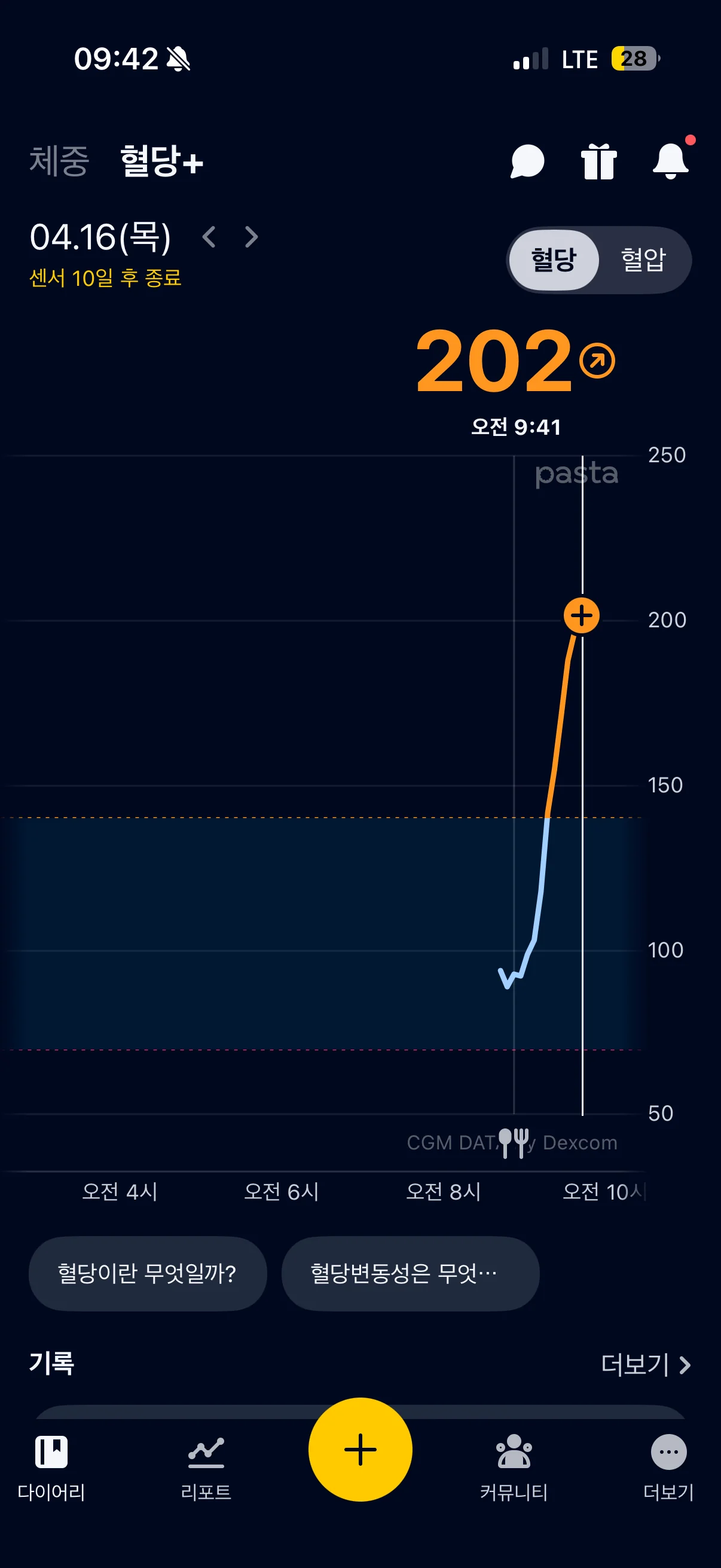 202. Am I in trouble?
Generally, the normal range for post-meal blood sugar is said to be below 140. Anything over 200 is a level that requires caution. And here I was, hitting 202 just from a bowl of porridge.
To be honest, I was startled. My first thought was, “This is bad.” My second thought was, “Has it always been like this every time I ate?” I felt like I had been living in total ignorance.
But after a moment of reflection, I felt glad I had put this on. This was a number I never would have seen without measurement. Not knowing is scarier.
[!TIP] In the blood sugar graph, the blue area (approx. 70~140 mg/dL) is the normal range. Post-meal blood sugar is recommended to be below 140, and anything over 200 is considered a level for caution. However, keep in mind that CGM measures interstitial fluid, which can differ slightly from actual blood glucose.
Future Plans
I plan to keep a daily record for the next 10 days. What makes it go up? Does exercise bring it down? Does sleep have an effect?
Today is Day 1. The day I hit 202 with a bowl of porridge.
Should I just drink water tomorrow?