![[Tesla Log #3] 2022 HW3 Model Y, Finally Buying FSD](/ko/tesla-hw3-fsd-upgrade/cover_hu_88b03f50d29be865.webp)
TL;DR
- I rushed to buy FSD following the US buyout restriction news in March, combined with the recent v14 Lite announcement, fearing it might be restricted in Korea soon.
- The latest earnings call officially confirmed that unsupervised FSD is impossible due to HW3 hardware limits (memory bandwidth).
- However, the news of ‘Supervised FSD (v14 Lite)’ coming in June 2026 made me pull the trigger.
A 2022 Tesla Model Y (HW3) manufactured in Fremont, US. Shortly after delivery, I purchased EAP (Enhanced Autopilot) and had been using it well. As I wrote in a previous post, I agonized over whether to buy FSD when the news broke that the buyout option was ending. But back then, knowing it only applied to the US, I held off. “It’s probably fine in Korea for now.”
But the recent earnings call announcing the rollout of ‘Supervised FSD v14 Lite’ changed my mind. Fearing the buyout option might soon disappear here too, I rushed to hit the purchase button.
Table of contents
The Q1 2026 Earnings Call Shock, and the Decision
The deciding factor was Elon Musk’s recent Q1 2026 Earnings Call.
“HW3 lacks the capability to achieve unsupervised FSD.”
Musk officially admitted HW3’s limitations. The biggest chokepoint was Memory Bandwidth. HW3’s memory bandwidth is only 1/8th of the latest AI4 (HW4) hardware, meaning there is a physical limit to processing high-performance AI models in real time.
Hearing this, I felt a bit bitter realizing, “Ah, my car is old news now.” But the next part moved me.
‘FSD v14 Lite’ for HW3 vehicles scheduled for rollout in June 2026.
This is a lightweight version of the official v14 for AI4, tailored for HW3’s lower specs. While full unsupervised FSD is off the table, the ‘Supervised FSD’ features are expected to vastly improve.
“If unsupervised is impossible anyway, let’s at least fully enjoy the supervised version.” The moment this thought crossed my mind, I opened the app.
Upgrading from EAP to FSD
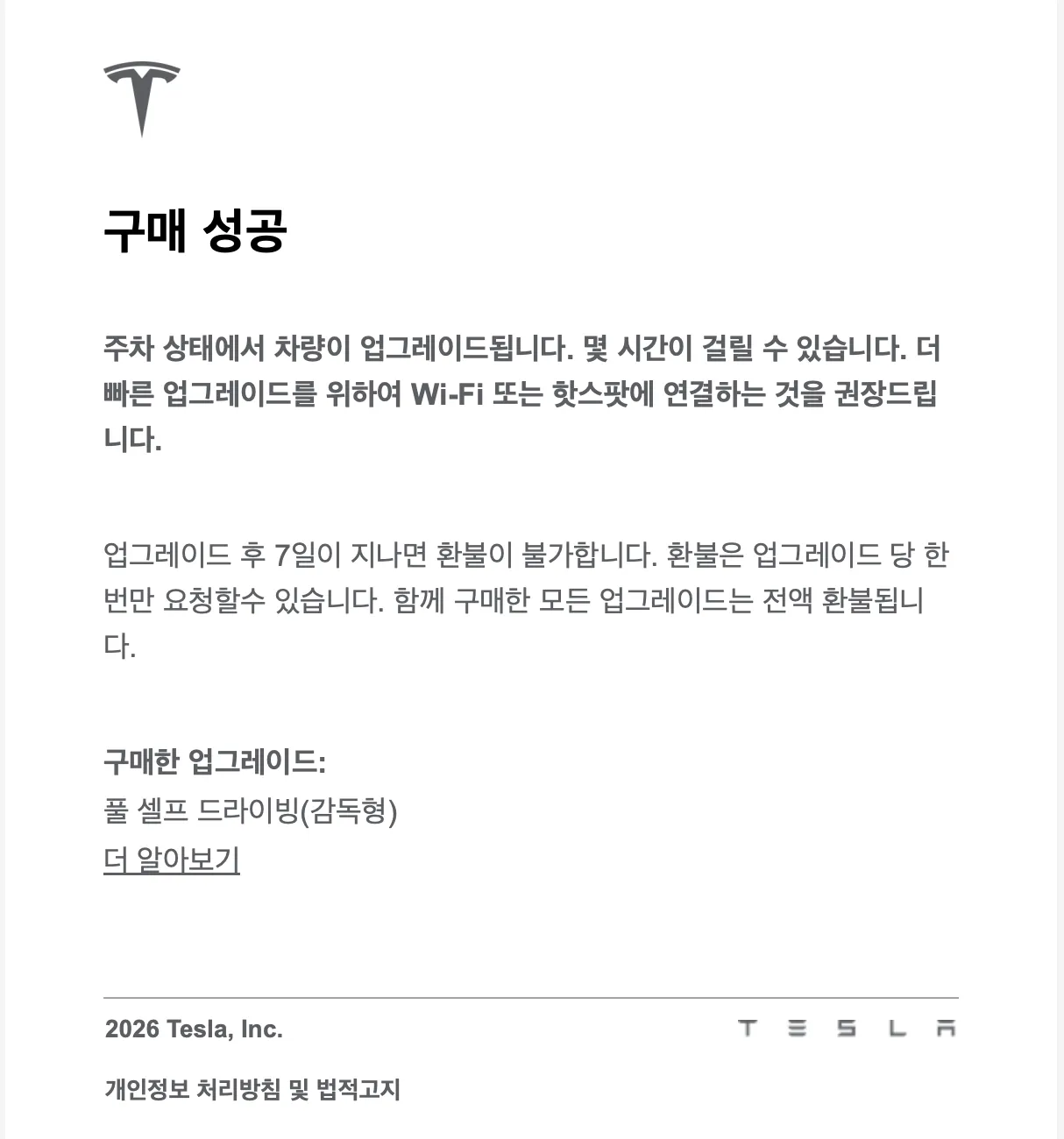 The payment screen to go from EAP to FSD. I finally moved past the screen I always hesitated on.
The payment process was anti-climactically simple. Since I already had EAP, I only had to pay the difference. A few taps in the Tesla app, and the credit card notification rang.
Bought it. Paid for it. I thought my hands would shake, but surprisingly, I felt numb. “Well, future me will take care of the credit card bill… lol” The reasons were complex, but pressing the button took only a second.
The Irrational Reason for Insisting on a Buyout Over Subscription
Rationally speaking, buying FSD outright right now is not a smart choice. HW3’s hardware limits are clear, and unsupervised FSD is impossible. Plus, paying for the monthly subscription is much cheaper.
So why drop a huge amount of cash on it?
The biggest reason was my stubbornness to ‘fully own my car’s features.’ Features that only stay active if you pay monthly feel somewhat like borrowing. Even if it’s not perfect right now, I wanted to experience FSD’s evolution as entirely mine until the day I sell the car. Perhaps it’s just an irrational consumption driven by treating the car as more than just a means of transport—like a toy.
[!CAUTION] If you are an HW3 owner, you must evaluate your driving style and cost efficiency before buying FSD. If you expect full unsupervised FSD, you will be disappointed, and if you value cost-effectiveness, the subscription is far better. You should approach it fully aware that it is purely the ‘highest level of driver-assistance feature (supervised).’
Will It Save My Bumper-to-Bumper Commute?
Honestly, even though it’s supervised FSD, I want to fully experience it on my HW3 Model Y. I’ve only made the payment and haven’t properly tested it on the road yet, but my expectations for the v14 Lite coming out in late June are high.
Especially that fatigue from meaninglessly stopping and going in bumper-to-bumper traffic every single day. If Supervised FSD could just take over this tedious commute from home to work, how much would my quality of life improve?
Physical hardware limits aside, I’m curious to see how smooth the driving will be through software optimization within restricted resources. For now, I’ll start by lightly testing the newly unlocked features on tomorrow’s commute.