![Featured image of post [Living Tip] Winter Washer OE Error Fix: Manual Draining When Pipes Are Frozen](/ko/washing-machine-winter-oe-error-manual-drain-fix/cover_hu_e6fe0a672fb34552.webp)
Direct Answer & TL;DR
- Winter OE Culprit: If the temperature drops suddenly, the OE (Outlet Error) is likely caused by water freezing inside the drain hose or pump.
- Emergency Fix: If you cannot thaw the drain pipe right away, open the manual drain hose at the bottom of the washer to force the water out.
- Finish the Cycle: Once you manually drain the water, the sensor will detect it as “drained.” You can then run a Rinse + Spin cycle to save your wet laundry.
Introduction: The Day the Washer Froze
Recently, we faced a severe cold wave with temperatures dropping below -10°C. Like any other day, I started a load of laundry, but the machine suddenly stopped and started beeping with an OE (Outlet Error) code.
“Did the drain pipe freeze?”
Usually, an OE error means a clogged filter or a kinked hose. But in this freezing weather, it almost certainly meant ice blocking the drain or the pump.
The problem was that my drain pipe is hidden deep behind the machine, making it difficult to thaw with a hair dryer or warm water. My laundry was trapped inside a drum full of water, and I had no immediate way to melt the ice. Here is how I used the “Manual Drain & Escape” method to resolve the situation.
The Solution: If You Can’t Melt It, Drain It Yourself
The reason the washer throws an OE error is simple: “I tried to push the water out, but the water level isn’t going down.”
Even if the drain motor runs, the ice blocks the path. Strategies involving thawing take time. However, if you drain the water manually, the machine can proceed to the next step (Rinse/Spin).
Step 1: Locate the Emergency Drain Hose
Open the small square service cover at the bottom front (usually left or right corner) of your washing machine. Inside, you will find the drain pump filter and a small black residual water removal hose.
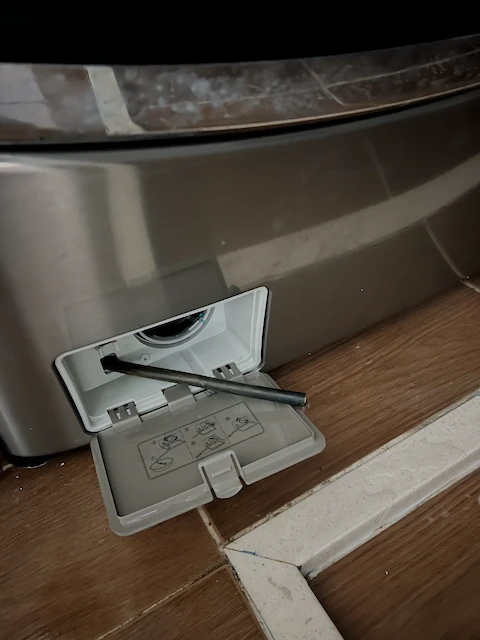 Opening the service cover at the bottom of the machine
Step 2: Manually Drain the Water (Repetitive Work)
The washer is currently full of rinse water. A small cup won’t be enough.
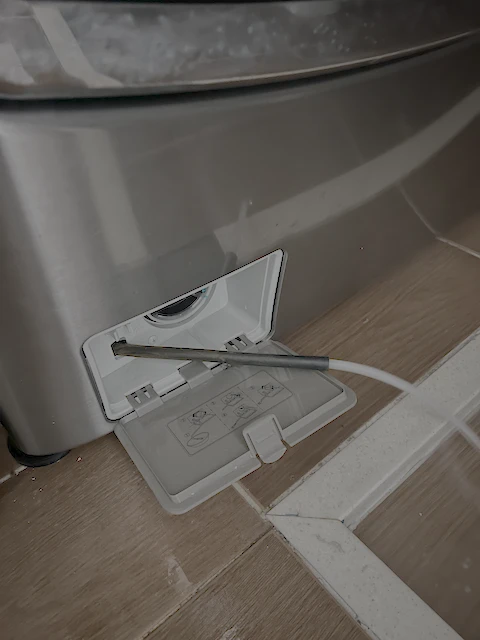 Uncorking the hose and collecting water in a tray
- Place a large shallow tray or pan under the hose.
- Pull out the drain hose and uncork the cap.
- Water will gush out.
- When the tray is full, quickly recap the hose, empty the tray, and repeat.
[!NOTE] My Experience: There is surprisingly a lot of water. I had to empty a large basin about 3 to 4 times. My arm hurt a bit, but I had to hustle to save the laundry.
Step 3: Finish with Rinse + Spin
Once no more water comes out, tightly close the hose cap and put it back in place. Close the cover.
Now, turn the power back on and select the ‘Rinse + Spin’ (or just Spin) cycle. Since the water is gone, the machine’s sensor thinks “draining is complete” and skips the failed drainage attempt, moving directly to spinning your clothes dry.
Conclusion: Be the Human Drain Pump
Of course, the permanent solution is to thaw the frozen drain pipe or pump. But if you need to leave for work immediately or can’t spend hours fighting with a hair dryer on a freezing balcony, this is the best emergency fix.
- Drain water manually.
- Spin the clothes and get them into the dryer.
- Worry about melting the pipe after the laundry is safe.
If you encounter a sudden Winter OE error and can’t thaw the pipes, don’t panic. Find the manual drain hose. Just by removing the water yourself, you can avoid the nightmare of leaving wet laundry rotting in the machine.