![Featured image of post [Tesla Model Y Triangle Accident #1] Snowy Road Collision & Insurance Reality: The Start of a Triple-Panel Repair](/ko/tesla-model-y-snowy-road-accident/cover_hu_3c7557ef8cbf14c2.webp)
Direct Answer & TL;DR
- The Accident: I hit the brakes at 12 mph (20 km/h) on a snowy downhill road, but the car kept sliding until I rear-ended the vehicle ahead.
- Repair Cost Controversy: The initial estimate was ~$830, but it suddenly jumped to ~$1,800 after 100% fault was confirmed. I want the car to be perfectly restored, but the sudden jump was quite a surprise.
- Injury Claim: The other driver claimed a headache and requested an injury claim. I sincerely hope for their quick recovery, while also hoping the insurance system is used fairly and reasonably.
Introduction: One Ordinary Morning Commute, The Unavoidable Slide
On what seemed like an ordinary morning commute, the snow that had fallen the previous evening had frozen into a giant trap. As I was heading down a familiar hill, I saw the car in front getting closer and hit the brakes.
“Grrr-chk-chk!”
Tesla’s ABS worked extremely hard to slow me down and minimize the impact, but physics on ice still has its limits. I tried to swerve into the side lanes, but they were already occupied by a solid line of other vehicles, leaving me with no escape. Eventually…
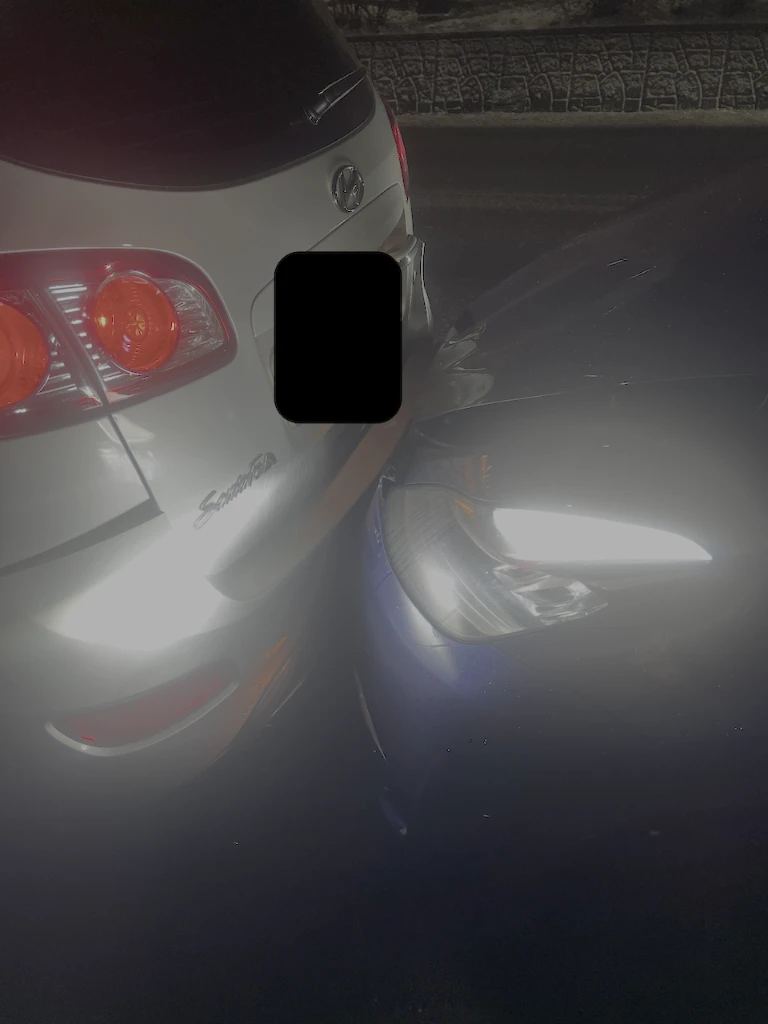 The moment my Model Y met the rear of a Santa Fe on a snowy downhill. My heart still hurts.
While the initial shock was overwhelming, the process of securing the scene led to a deeper reflection on my Model Y’s specific damage and the technical implications of a “Triangle” (Sambakja) accident.
Technical Profile: The “Triangle” (Sambakja) Accident Defined
In the Korean used-car market, this term refers to damage to the three major front components:
- Bonnet (Hood): The cover for the front trunk
- Front Panel: The structural frame supporting the radiator, etc.
- Fender: The body panel above the wheels
Looking at my Model Y, it was “honestly” damaged in all three spots. (Tesla, you didn’t have to be that honest…ㅠㅠ)
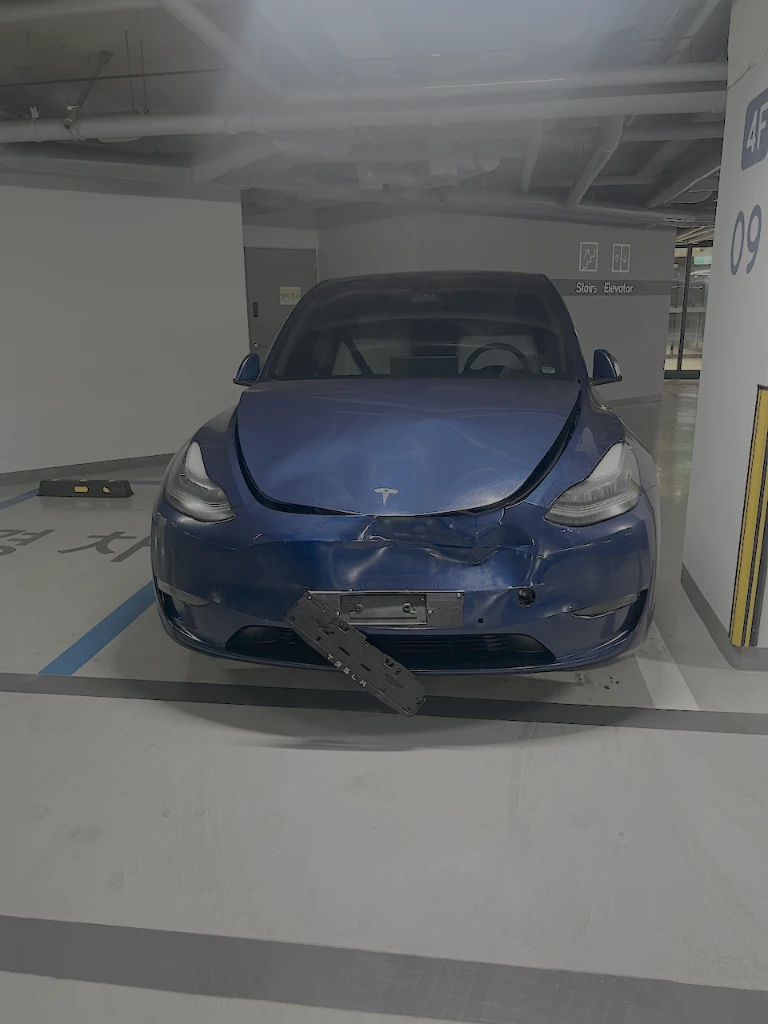 A dented hood and a dangling license plate. The aftermath of a Triangle accident.
After identifying the mechanical damage, the focus shifted to the insurance settlement process. However, this phase introduced unexpected volatility in the cost estimates.
Insurance Status: Shifting Estimates and the Muffler Controversy
Initially, Samsung Fire & Marine Insurance sent an estimate of about $830 (1.1M KRW) for the other car. I thought, “Well, it’s my fault, so let’s get this over with.”
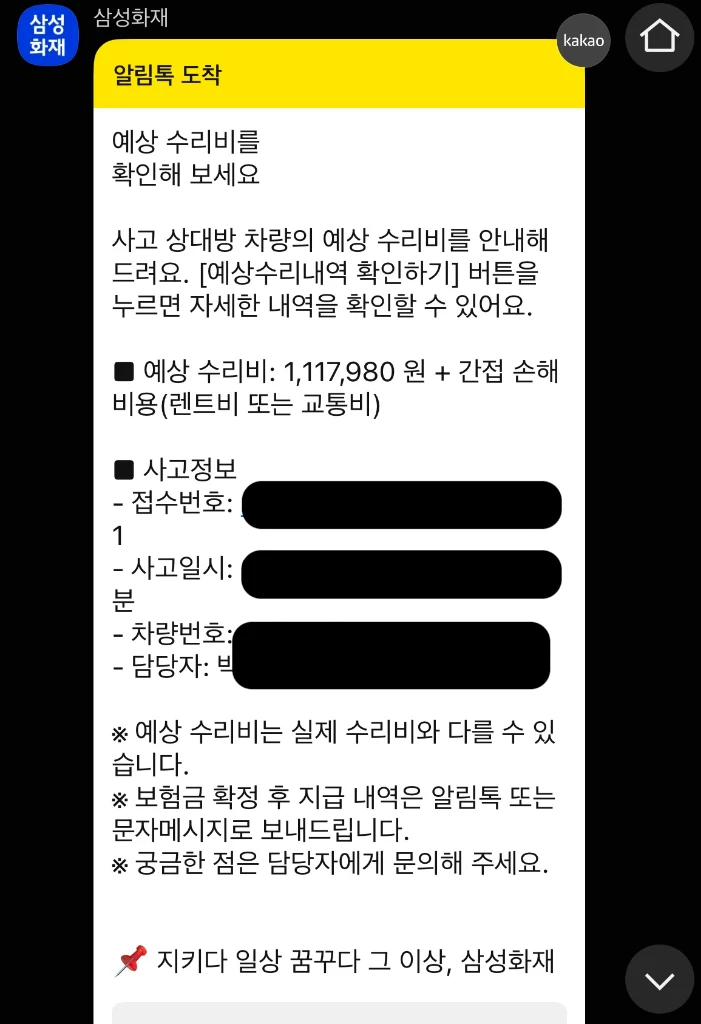 The first estimate was around $830.
But then, everything changed as soon as my fault was confirmed at 100%.
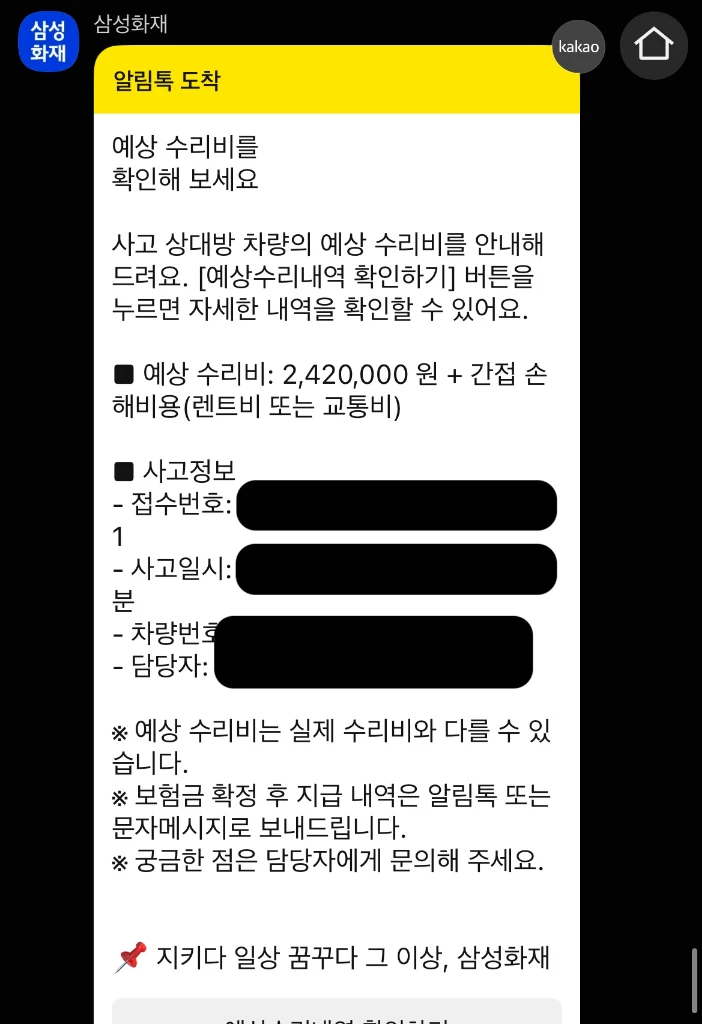 The estimate jumped to $1,800, citing muffler repairs.
Suddenly, they claimed the muffler (exhaust pipe) needed repair, and the bill jumped to $1,800 (2.4M KRW). Could braking at 12 mph and sliding into a low-speed collision really damage a muffler that much?
Of course, as experts say, there could be internal damage. From the victim’s perspective, it’s only natural to want their car restored to its pre-accident condition. As the person at fault, I also want their property to be fully compensated. However, seeing the gap in estimates before and after the 100% fault confirmation, I can’t help but feel a bit concerned about whether the insurance process is being unnecessarily inflated.
Beyond the objective material assessments, the situation became more complex with the arrival of medical claim notifications.
Personal Injury: Victim Recovery and Fair System Utilization
Beyond the vehicle damage, what made my heart heavier was the news of the personal injury claim. The other driver seemed fine right after the accident, but later said they had a headache and requested a claim.
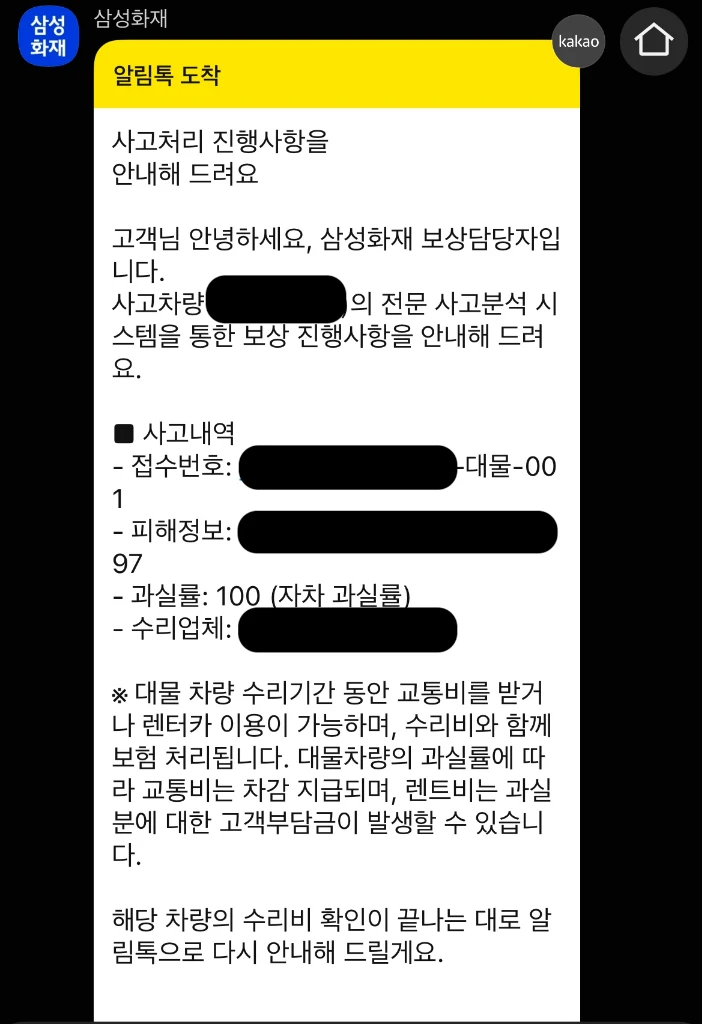 100% fault confirmed. Now everything is my responsibility.
Honestly, I genuinely hope the other person recovers fully and quickly without any lasting effects. Nothing is more upsetting than someone getting hurt.
However, since it was a minor impact while sliding at 12 mph, I also cautiously hope that the treatment process remains focused on recovery rather than becoming a misuse of the insurance system. I hope for a healthy outcome where the victim is well cared for, and I fairly compensate for my responsibility.
Conclusion & Lessons Learned: No One Wins on Ice
Here’s what I learned the hard way:
- Drive extra slow on snowy hills: Tesla’s advanced tech and ABS certainly helped prevent a much bigger accident, but on ice, the laws of physics are the ultimate boss.
- Flexible Insurance Estimates: I experienced firsthand how an estimate can stretch like a rubber band depending on the fault ratio.
- The Reality of Claims: I hope the other person recovers fully and stays healthy. Even if questions remain, I’ve realized it’s best to trust the insurance company’s fair judgment when you’re at 100% fault.
Related Series Posts
- [Tesla Model Y Triangle Accident #2] Repairing was as Hard as the Accident: The Booking Battle and Handling Lost Plates
- [Tesla Model Y Triangle Accident #3] Minor Impact, Major Repair: Is the Triangle Accident Inevitable?
It is natural and important for the other car to be perfectly repaired and for the victim to regain their health. I hope this record is seen as an honest reflection of my desire for the process to be fair and in line with the true purpose of insurance.
How is your winter driving going? I hope you don’t become the star of a “Triangle” accident like I did!