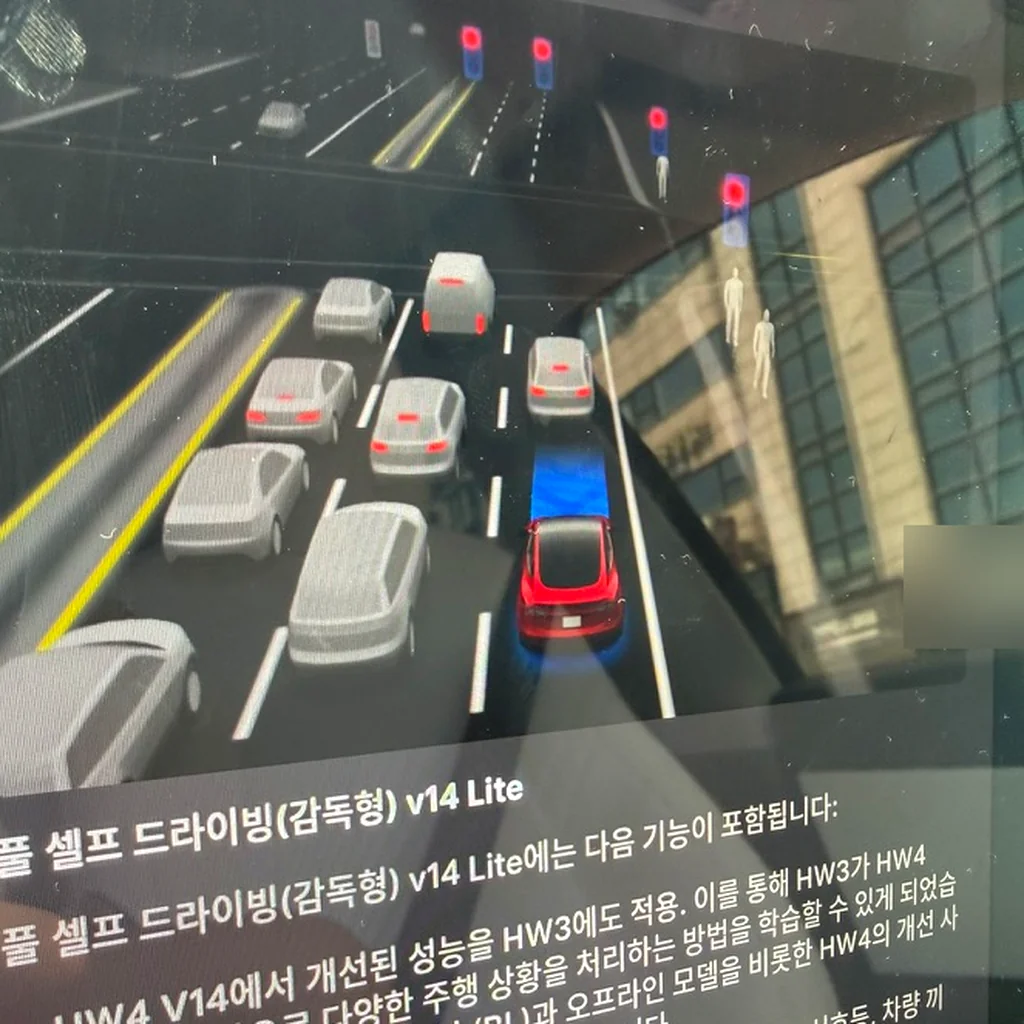
 The road v14 Lite drew on the HW3 screen. Three months of waiting for this view.
Direct Answer & TL;DR
- FSD (Supervised) v14 Lite landed on my 2022 HW3 Model Y on August 8. I paid for it in early May and waited three months.
- One month in: I let it handle highways and unfamiliar roads. I drive my own commute. The road to Chuncheon was easy enough that I didn’t even glance at the nav.
- By the app’s stats, from August 8 to September 26 I drove 2,529 km, and FSD handled 1,308 km of it — 52%. The longest single stretch was 109.4 km, on the drive to Chuncheon.
- It’s still supervised, though. Once, on a straight stretch in the city, the car drifted toward the curb in the rightmost lane. I’ve watched it more closely since.
“Does the car really drive itself?”
My kids asked. They were thrilled the car could go on its own. In January I weighed whether to buy FSD at all, and in May I finally paid for it. That post ended with a question: would it save my gridlocked commute?
A month of driving answered that. What got saved wasn’t the commute.
Table of contents
Promised late June, arrived August 8
Laid out by date, the wait looked like this.
| Date | What happened |
|---|---|
| January | News that FSD’s one-time buyout was ending. HW3 owners start weighing their options |
| April | Tesla’s Q1 earnings call: “Unsupervised FSD is impossible on HW3, v14 Lite ships late June” |
| Early May | Upgraded from EAP to FSD (₩4.52M / ~$3,300) |
| June 29 | Elon Musk announces on X that rollout to HW3 (AI3) vehicles has started |
| July 10 | Tesla Korea begins the domestic rollout |
| August 8 | Arrives on my car |
Tesla FSD v14 Lite is rolling out to customers with our AI3 hardware
The domestic rollout covers US-built Model 3 and Model Y cars with HW3 and an active FSD purchase. Mine was built in Fremont, so it qualified. It was a staggered rollout — I just waited an extra month for my turn.
The earnings call’s “late June” was about the US.
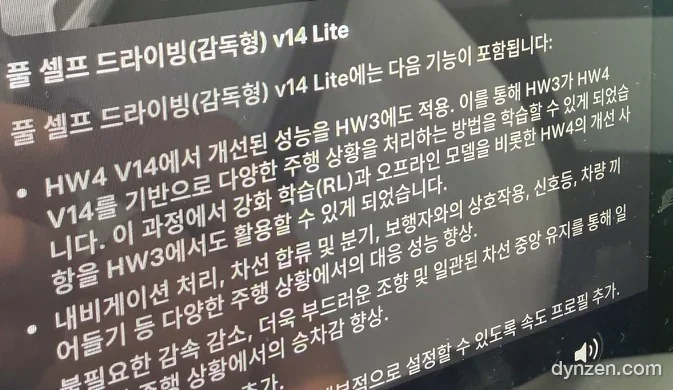 “Improvements from HW4 V14 applied to HW3.” Three months for this one line.
The first line of the release notes explains what this update actually is: the driving behavior HW4’s v14 learned, taught to HW3. It says the process used reinforcement learning and offline models. Below that: better navigation handling, lane merges and splits, improved pedestrian response.
Four modes, I run Standard
There are four driving styles: Sloth, Chill, Standard, Hurry.
Per the official release notes, this profile sets both speed and lane choice together. It blends the driver’s profile, the speed limit, and surrounding traffic to pick a speed, and Sloth drives slower and picks lanes more conservatively than Chill. What I noticed driving it felt a little different — how often it changes lanes registers before speed does.
I usually leave it on Standard. In this mode the car mostly sits in the second lane from the left, angling for a faster lane when it can.
The road to Chuncheon, without watching the nav
I go to Gangwon Province, the mountainous province east of Seoul, often. Chuncheon is one of the regular stops. On the highway, v14 Lite is very good.
It picks lanes with traffic flow and merges onto and off the highway on its own, following the nav route. I don’t have to watch the nav screen. That alone cut a big chunk of the fatigue out of long drives.
Driving from my place in the Seoul area to Chuncheon, the only part I drove myself was pulling out of the home parking lot. From there to the destination in Chuncheon, FSD drove the whole way. The app’s longest streak on record, 109.4 km, is from that day.
It felt like having a chauffeur. It was great.
One gripe: it doesn’t change lanes early. It waits until 200–300 meters before an exit or merge to move over.
And there was a side effect I didn’t expect. Long drives got enjoyable. Sometimes enjoyable enough to make me drowsy.
The car drives, I supervise — and supervising alone can get my eyelids heavy. Supervised, in the end, means I still have to stay awake.
In the city, the car hesitates too
I was doing 38 km/h through the city when the screen suddenly filled with confetti and a message popped up in the middle: 100 km, streak achieved. In the top right, next to the current mode, Standard, it read “100.0 km streak.” It seems to be counting the distance FSD covered without me taking over.
The car did the driving. I got the confetti.
It handles regular roads well too. City traffic is just more complicated than the highway, apparently.
Every so often it leaves the turn signal blinking and hesitates. I can see it weighing whether to turn the wheel or not.
Driving back from Gimpo, toward the curb
That day we were coming back from visiting the family’s ancestral graves in Gimpo, a city next to Seoul. My family was in the car.
I was in the rightmost lane. There was no side road to my right, nothing to turn into. It was a straight shot.
Then the right turn signal came on out of nowhere. The car started drifting right, slowly. There was nothing over there but a curb.
I switched FSD off and grabbed the wheel. It was a close call.
I figure it’s an early version, so things like this can happen. Still, I’ve paid closer attention ever since. Tesla Korea said the same thing in its rollout notice: the system may not perfectly recognize every obstacle and road condition, so drivers should stay alert at all times and be ready to take control immediately.
My commute, I drive it better
Back in May, the commute was what I was most hoping FSD would fix. A month in, I drive it myself instead. I know the road I take every day better than the car does. On that road, my driving is snappier than FSD’s. Still, now and then I let FSD handle the commute too.
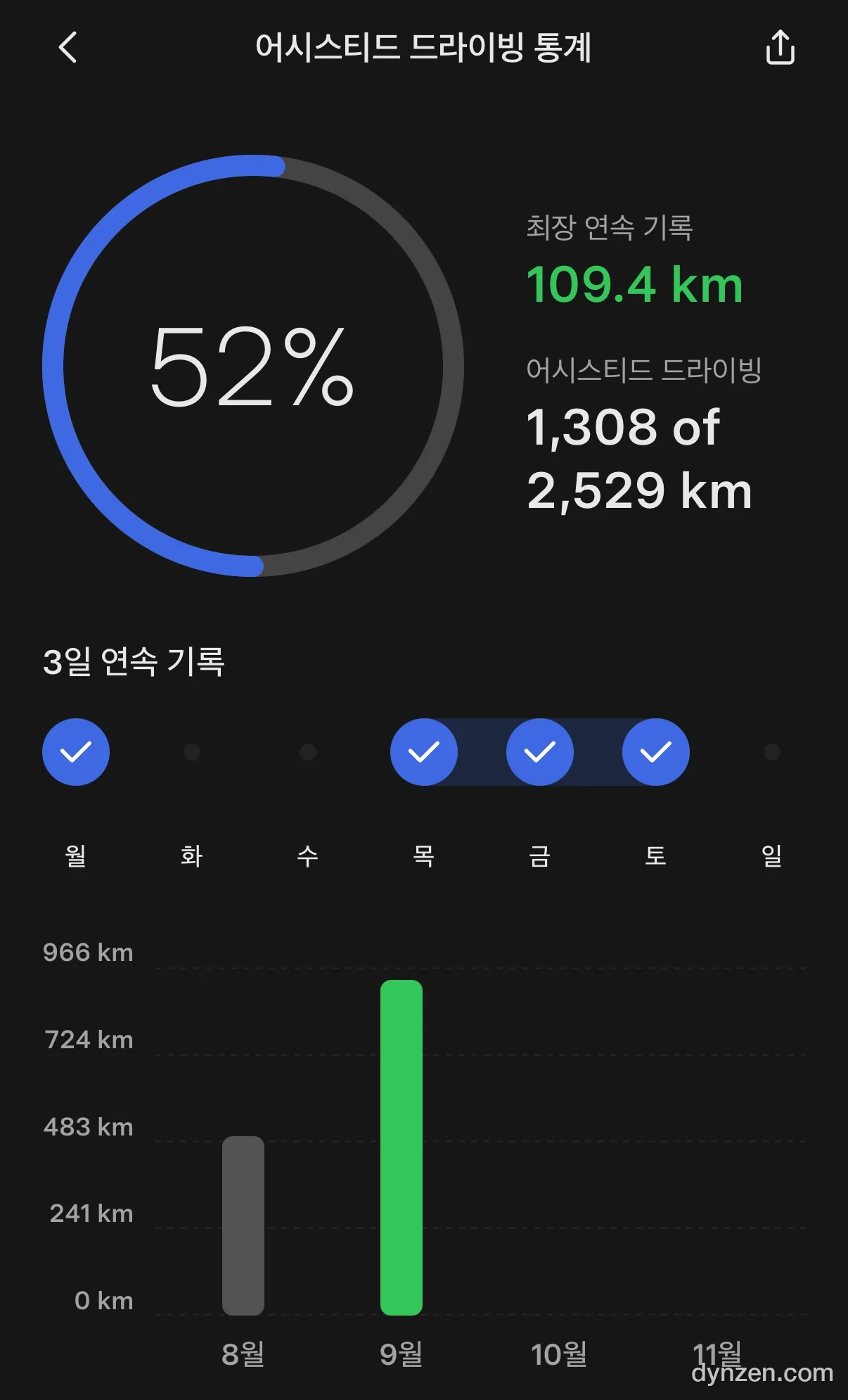 August 8 through September 26. Of 2,529 km, FSD drove 1,308 km.
Open the Assisted Driving stats in the Tesla app and it’s a little over half. I drive the roads I know well, FSD drives the long and unfamiliar ones, and it ends up splitting almost exactly down the middle.
On unfamiliar roads, it’s the opposite — FSD shines. Here’s how a month of driving broke down by situation.
| Situation | One month in | My call |
|---|---|---|
| Highway / long distance | Picks lanes with traffic, merges and exits on its own. Lane changes come late, 200–300m out | Leave it to FSD |
| Unfamiliar roads | No need to watch the nav, which is a relief | Let FSD handle it |
| City streets | Drives well but occasionally hesitates with the signal on. Drifted toward a curb once | Supervise more closely |
| Commute | I know the road, so I’m snappier than FSD | Mostly drive myself. Sometimes hand it over |
It’s impressive this runs on HW3 at all — but
v14 Lite is a lite version, true to its name. I pulled together official announcements and outlet coverage to see how it stacks up against HW4.
| Item | HW3 (my car) | HW4 (AI4) |
|---|---|---|
| Camera resolution | 1.2MP | 5MP |
| Memory bandwidth | About 1/8 of HW4 | Baseline |
| FSD version | v14 Lite (trained on HW4’s v14 driving behavior) | v14 |
| Unsupervised FSD | Not possible (confirmed on the Q1 earnings call) | Tesla’s stated goal |
| Domestic rollout condition | US-built Model 3/Y + active FSD | — |
The camera resolution gap is more than fourfold, and the memory bandwidth — the bottleneck everyone points to — is eightfold. Given all that, handling a highway on its own, exits and merges included, is honestly impressive.
Back in January I bet on Musk’s promise: if HW3 wasn’t enough, Tesla would upgrade the hardware. At the Q1 earnings call, Tesla laid out two paths for people who’d bought FSD on HW3 — a discounted trade-in to an AI4 vehicle, or a free swap of the computer and cameras. Pricing and timing for either haven’t been announced yet.
So my wish right now is simple. A few more updates, and I’d like to ride an FSD in this car that doesn’t drift toward curbs.
“Does the car really drive itself?”
A month in, my answer to the kids is half yes. In numbers, it’s 52%. On the way to Chuncheon, the car drove itself. On the way back from Gimpo, I had to grab the wheel.
Our household gained a chauffeur. One who drifts toward the curb now and then, though, so I still keep my eyes on the road from the driver’s seat.
🔗 References
- Elon Musk on X: “Tesla FSD v14 Lite is rolling out to customers with our AI3 hardware” — June 29, 2026 announcement that rollout to HW3 (AI3) vehicles had started
- 테슬라, 국내서 FSD v14 Lite 배포 시작…미국산 모델3·Y에 적용 - 이투데이 — July 10 domestic rollout start, eligible vehicles, driver-attention notice (Korean-language source)
- Tesla FSD v14 Lite wide release (2026.20.6.11) release notes - Tesla Oracle — the four speed profiles and how speed/lane choice is set
- Everything Tesla Announced During Its Q1 2026 Earnings Call - Not a Tesla App — unsupervised FSD not possible on HW3, trade-in and free-swap options for HW3 FSD buyers
- Tesla confirms HW3 FSD limitations, v14 lite timeline - TeslaMagz — HW3 memory bandwidth roughly 1/8 of HW4, swap pricing/timing not yet announced
- Tesla’s HW3 and HW4 Cameras - Not a Tesla App — camera resolution 1.2MP vs. 5MP
- [Tesla Log #2] FSD Buyout Ending: Should HW3 Owners Buy?
- [Tesla Log #3] 2022 HW3 Model Y, Finally Buying FSD